 Add to Chrome
 Add to Firefox
 Add to Edge
FinGuard: Detecting Financial Regulatory Non-Compliance in LLM Interactions
May 28, 2026
As large language models (LLMs) are increasingly deployed in financial services, a single non-compliant interaction can expose institutions to regulatory penalties and direct consumer harm. Existing guard models are built around general harm taxonomies and overlook violations grounded in specific financial regulations. We address this gap with a regulation-driven pipeline that operates directly on regulatory documents, inducing a financial compliance risk taxonomy and synthesizing grounded training data without any predefined violation categories. Instantiating the pipeline on Chinese financial regulations, we release \textbf{FinGuard-Bench}, to our knowledge the first benchmark for financial regulatory compliance detection, with expert-annotated labels at both the query and response levels. We further train \textbf{FinGuard}, a financial compliance detection model built on Qwen3-8B and trained on the regulation-grounded data via supervised fine-tuning and self-play reinforcement learning. On FinGuard-Bench, FinGuard substantially outperforms all baselines, including dedicated guard models and much larger general-purpose LLMs such as Qwen3.5-397B-A17B and GPT-5.1. Furthermore, FinGuard also preserves general safety capabilities and adapts to unseen institution-specific policies using policy documents alone. We will publicly release the code, prompts, and resources used in this work on GitHub.

ESC-Skills: Discovering and Self-Evolving Skills for Emotional Support Conversations
May 27, 2026Existing emotional support conversation (ESC) systems mainly rely on end-to-end response generation or coarse strategy supervision, offering limited interpretability and little support for systematic skill improvement. We propose ESC-Skills, a skill-centric framework that discovers and self-evolves executable emotional support skills. We first model localized support interactions as Intervention Units (IUs), which capture state--action--outcome dynamics between seeker states, support interventions, and post-response emotional changes. Based on IUs extracted from both successful and failed ESC dialogues, we construct the ESC-Skills Bank, a repository of executable emotional support skills containing intervention guidance, applicability conditions, expected outcomes, and potential risks. To further improve robustness, we introduce a multi-profile self-evolutionary refinement framework in which an ESC agent interacts with diverse simulated seeker profiles under SAGE evaluation. The resulting interaction traces are analyzed to identify missing skills, unsafe interventions, and profile-specific failure patterns, which are then used to refine the Skills Bank through simulation-based verification. Experimental results demonstrate that ESC-Skills improves both response-level quality and dialogue-level emotional outcomes while providing more interpretable and controllable support behaviors. We will release the code, prompts, and ESC-Skills Bank at https://github.com/aliyun/qwen-dianjin.
Modeling Multiple Support Strategies within a Single Turn for Emotional Support Conversations
Apr 20, 2026Emotional Support Conversation (ESC) aims to assist individuals experiencing distress by generating empathetic and supportive dialogue. While prior work typically assumes that each supporter turn corresponds to a single strategy, real-world supportive communication often involves multiple strategies within a single utterance. In this paper, we revisit the ESC task by formulating it as multi-strategy utterance generation, where each utterance may contain one or more strategy-response pairs. We propose two generation methods: All-in-One, which predicts all strategy-response pairs in a single decoding step, and One-by-One, which iteratively generates strategy-response pairs until completion. Both methods are further enhanced with cognitive reasoning guided by reinforcement learning to improve strategy selection and response composition. We evaluate our models on the ESConv dataset under both utterance-level and dialogue-level settings. Experimental results show that our methods effectively model multi-strategy utterances and lead to improved supportive quality and dialogue success. To our knowledge, this work provides the first systematic empirical evidence that allowing multiple support strategies within a single utterance is both feasible and beneficial for emotional support conversations. All code and data will be publicly available at https://github.com/aliyun/qwen-dianjin.
DianJin-R1: Evaluating and Enhancing Financial Reasoning in Large Language Models
Apr 22, 2025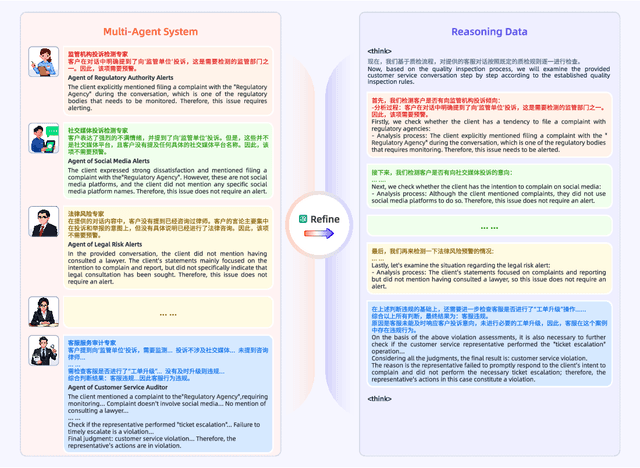
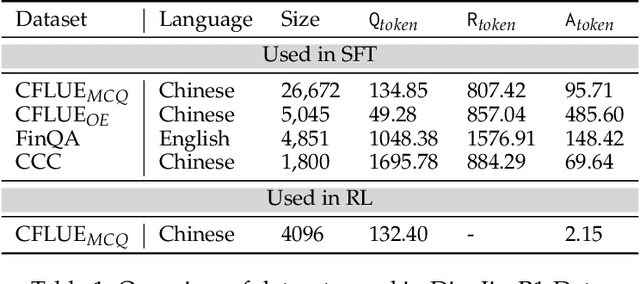
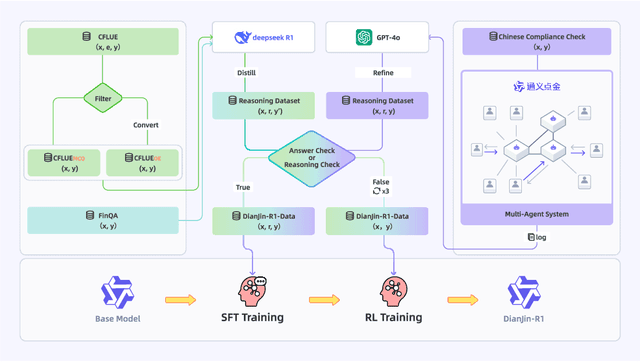
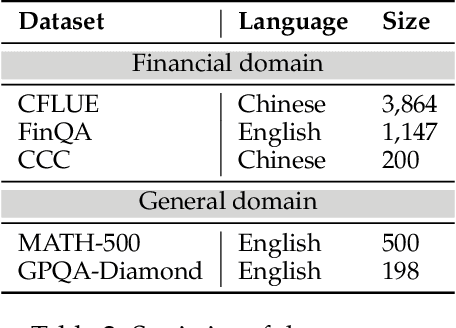
Effective reasoning remains a core challenge for large language models (LLMs) in the financial domain, where tasks often require domain-specific knowledge, precise numerical calculations, and strict adherence to compliance rules. We propose DianJin-R1, a reasoning-enhanced framework designed to address these challenges through reasoning-augmented supervision and reinforcement learning. Central to our approach is DianJin-R1-Data, a high-quality dataset constructed from CFLUE, FinQA, and a proprietary compliance corpus (Chinese Compliance Check, CCC), combining diverse financial reasoning scenarios with verified annotations. Our models, DianJin-R1-7B and DianJin-R1-32B, are fine-tuned from Qwen2.5-7B-Instruct and Qwen2.5-32B-Instruct using a structured format that generates both reasoning steps and final answers. To further refine reasoning quality, we apply Group Relative Policy Optimization (GRPO), a reinforcement learning method that incorporates dual reward signals: one encouraging structured outputs and another rewarding answer correctness. We evaluate our models on five benchmarks: three financial datasets (CFLUE, FinQA, and CCC) and two general reasoning benchmarks (MATH-500 and GPQA-Diamond). Experimental results show that DianJin-R1 models consistently outperform their non-reasoning counterparts, especially on complex financial tasks. Moreover, on the real-world CCC dataset, our single-call reasoning models match or even surpass the performance of multi-agent systems that require significantly more computational cost. These findings demonstrate the effectiveness of DianJin-R1 in enhancing financial reasoning through structured supervision and reward-aligned learning, offering a scalable and practical solution for real-world applications.
Speech Translation Refinement using Large Language Models
Jan 25, 2025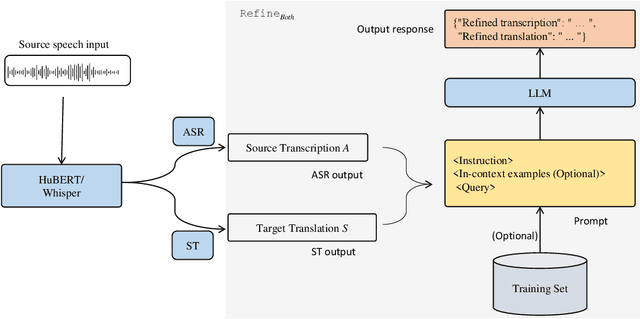
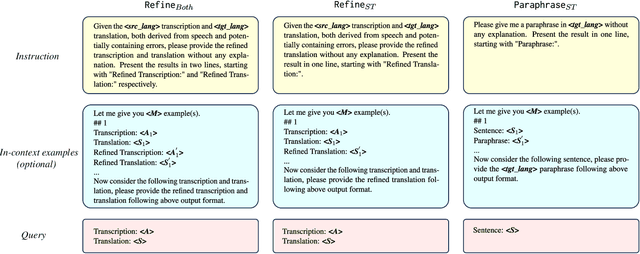
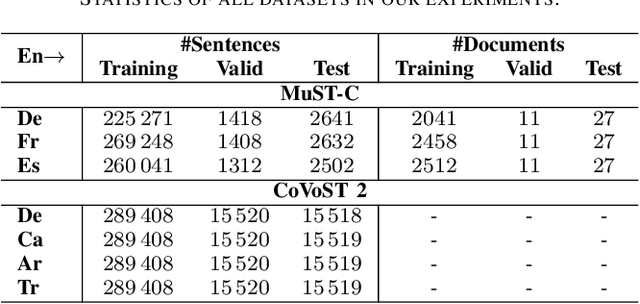
Recent advancements in large language models (LLMs) have demonstrated their remarkable capabilities across various language tasks. Inspired by the success of text-to-text translation refinement, this paper investigates how LLMs can improve the performance of speech translation by introducing a joint refinement process. Through the joint refinement of speech translation (ST) and automatic speech recognition (ASR) transcription via LLMs, the performance of the ST model is significantly improved in both training-free in-context learning and parameter-efficient fine-tuning scenarios. Additionally, we explore the effect of document-level context on refinement under the context-aware fine-tuning scenario. Experimental results on the MuST-C and CoVoST 2 datasets, which include seven translation tasks, demonstrate the effectiveness of the proposed approach using several popular LLMs including GPT-3.5-turbo, LLaMA3-8B, and Mistral-12B. Further analysis further suggests that jointly refining both transcription and translation yields better performance compared to refining translation alone. Meanwhile, incorporating document-level context significantly enhances refinement performance. We release our code and datasets on GitHub.